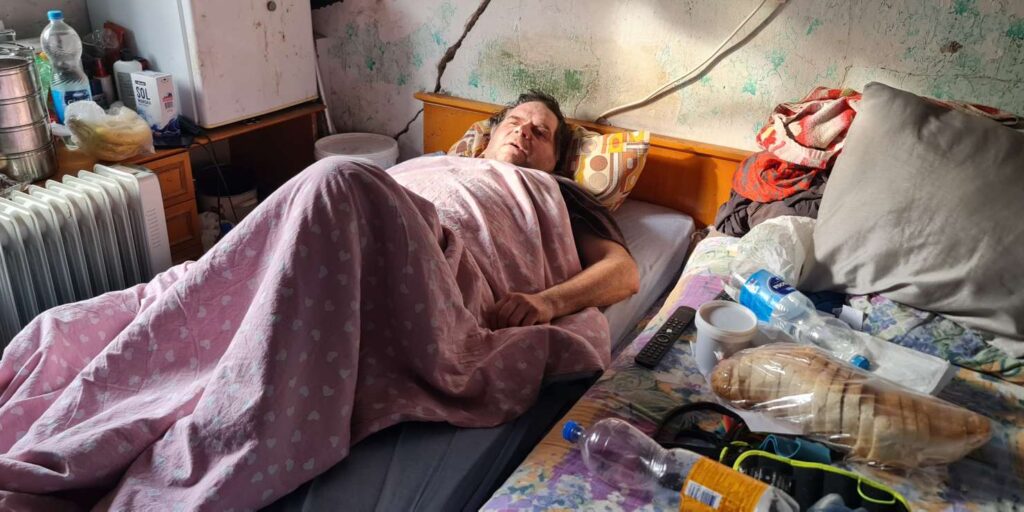
“What they do to the residents is inhumane. They are treated roughly — verbally, physically, and mentally. What I experienced broke me to the core of my dignity,” says a former employee of the Dom Janeza Krstnika care home in Ljubljana, run by the Trnovo parish priest Anton Kompare, who she claims also broke her psychologically.
She was hired as a cleaner but often worked as a caregiver, babysitter, and nursing assistant — far beyond her formal competencies or contractual duties. She does not like to recall that period, but her memories were stirred by the testimony of Nevenka Mihelčič, who publicly spoke out after her mother’s death in the same home, presenting photos and filing reports with the police and prosecutor’s office (as previously reported).
Her first day ended in tears
“On my first day I came home crying. In the dementia ward, I was shocked. The residents were in rooms with dirty floors and tables where they ate. Their bibs were filthy. I witnessed staff shouting at residents, treating them roughly, with no compassion in their care. We know how vulnerable people with dementia are, yet they deserve a respectful and clean environment. I stayed quiet, thinking that must just be the way it is, but cried all the way home.”
Care was often brutal, she continues.
“They rationed creams, so many residents had inflamed skin. Each person got only three diapers a day, regardless of need. I saw one resident literally thrown into bed because he was heavy and irritable. Another sat in his own excrement for two hours, trying to change himself. They gave them sleeping pills just to keep them quiet.”
Food and hygiene were equally degrading.
“Meals were sometimes served next to bags of used diapers and feces. Once, spoiled salami was on the table. The thermoses were rarely washed — old tea mixed with new. I remember one lady ringing for water, but the nurse said she’d have to wait until she finished her cigarette. I gave the woman a drink myself. The director, Anton Kompare, meanwhile, had service fit for a five-star hotel.”
Mandatory prayer and the ‘black mark’
Even the job interview began with prayer.
“The Lord’s Prayer and Hail Mary. Every morning we all had to attend mass in the chapel, or we got a black mark. We also prayed over the body of a deceased resident. It was deeply unsettling; I was shaken and afraid.”
The work, she says, broke her down completely.
“I cleaned three floors, the basement, lobby, offices, even the rectory. Sometimes I arrived at 5 a.m., though work started at 6, just to finish everything. There weren’t enough cleaning supplies, and I had to buy my own gloves. On weekends I helped with care, washing, feeding — all that, for about 830 euros a month. When my contract came up for renewal, the director prayed and suggested I come in early as a volunteer. I refused, and they didn’t renew my contract.”
The bottom of human dignity
“My experience there was distressing and sad. I felt as if my own mother or father were being treated that way. I broke down. It took three years and psychiatric help before I felt human again.”
She reported her experience to several inspection bodies, but nothing happened. She wishes to remain anonymous; her identity is known to the editorial team.
She is the seventh former employee to describe what she experienced at this care home. Before her, another ex-worker, Nada, had publicly spoken to Preiskovalno.si. All the testimonies are independent and unrelated.
The Nursing Chamber: Irregularities Found, but No Basis for New Inspection
The Nursing and Midwifery Chamber of Slovenia (Zbornica – Zveza) says that despite new testimonies of alleged abuse, poor hygiene, and possible misuse of sedatives, it will not initiate an extraordinary inspection at Dom Janeza Krstnika. The Chamber explained that two inspections had already been carried out — in 2020 and 2024 — so there was no legal basis for another. Both, however, identified recurring systemic and professional shortcomings.
The 2020 inspection found:
- Too few registered nurses.
- Inappropriate substitution of the head nurse by a technician.
- Inadequate documentation of care activities.
- Insufficient professional training.
- Violations of basic hygiene standards.
The home received 21 recommendations, of which 93% were reportedly fulfilled, leading the Chamber to conclude that management had “acted responsibly to correct deficiencies.”
The 2024 inspection revealed:
- Lack of a system to record and track complaints.
- Poor communication and professionalism in several areas of care.
- Overstepping authority regarding advance directives and family involvement.
- Wound care not performed according to clinical guidelines.
- Medication distribution by unqualified staff; mistakes not reported as safety incidents.
- Unprofessional communication between staff and relatives (personal calls, informal contacts).
- Insufficient training and disorganized work structure.
Twelve recommendations were issued; 77% were later implemented. The Chamber still assessed that the facility “responds appropriately and responsibly.” The remaining recommendations related mainly to work organization, immediate professional training, and ensuring care tasks align with staff competencies.
Sedatives, cleaners as caregivers, and dignity of residents
The Chamber claims that previous inspections did not confirm the use of sedatives to calm residents, as alleged. However, since inspections are not anonymous, that finding may be limited. They acknowledge that cleaners performing nursing duties would be a breach of competencies but say they did not find evidence of it. On hygiene, food, and living conditions, the Chamber notes that these issues fall outside its jurisdiction, which covers only nursing care.
Inspectorate: Oversight as Formality
In Slovenia, only one social inspector oversees eldercare homes. If family members do not report abuse while it’s ongoing, complaints cannot usually be verified later due to residents’ frailty or death.
Thus, in the case of Dom Janeza Krstnika, inspectors found no irregularities.
The Labour Inspectorate, which conducted two checks in 2024 focusing on employment law and worker dignity, also found none. But such inspections mainly review paperwork — policies, records, internal acts — rather than observing real-life care or interpersonal behavior. “Paper can bear anything,” as the saying goes; what truly happens during shifts is rarely inspected.
Witnesses Questioned Publicly
After almost a year, the prosecutor’s office dismissed Nevenka Mihelčič’s complaint against Director Anton Kompare and the head nurse for “abandonment of a helpless person.” Her claim concerned neglect of her mother Cecilija, who suffered severe wounds and allegedly inadequate care.
Nine witnesses were questioned — all employees of the home — and the decision not to prosecute, along with their testimonies, was sent to their employer, Father Kompare.
In such conditions, it is unrealistic to expect staff to testify openly against their superior; they would risk their jobs and workplace relations. This sense of fear and helplessness explains why families and employees rarely report suspected abuse — the procedures are slow, witnesses exposed, and outcomes nonexistent.
In the end, everything fades away: families withdraw, and residents — especially the frailest — silently endure their suffering. In a system where oversight relies on documents instead of lived experience, abuse often remains invisible.
The Priest: “Those Who Don’t Pray Are Less Loving and Respectful”
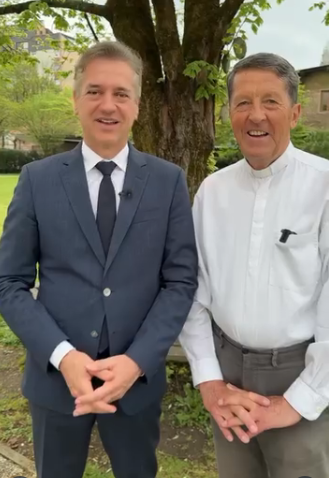
Prime Minister of Slovenia and Anton Kompare
Father Anton Kompare, photographed in recent months alongside Prime Minister Robert Golob, dismissed all allegations of neglect and abuse as lies. He insists he forces no one to pray:
“I’ve never forced anyone to do anything — but I like to invite people.”
Asked whether non-praying staff were treated differently, he replied:
“Why would I bully anyone? It’s their loss if they don’t come to prayer. They’re also less loving and respectful toward the elderly. You can’t have that in yourself — you need encouragement, a deeper reason, an invitation. Mother Teresa prayed for two hours every morning before helping the sick. Without that, she couldn’t have done it. It’s about the spiritual strength to approach people with respect.”
Although Preiskovalno.si independently verified all testimonies, Father Kompare insists it is all a fabrication — “a smear campaign that’s been going on for years. Everyone who checked has found it’s lies and malice.”
In a long phone call, he emphasized his pride in his staff:
“We have excellent personnel with strong credentials. Our work is hard, and the pay is low, so they need motivation. I’m proud of them — they’re warm-hearted, dedicated, good people. Families can fully trust our staff. There are no complaints, neither from employees nor relatives. We hold regular meetings where families can express opinions. What’s circulating are detours of lies. If things were really that bad, people would leave — but they don’t.”
Minister Simon Maljevac: A Year of Silence
The coalition agreement of the current government promises “dignified living in old age,” improved social care, and long-term support for seniors. Yet Nevenka Mihelčič spent a full year trying to meet Minister Simon Maljevac — without success.
This is the same minister who, after the case of a trainee attacking a dementia patient in Trebnje (and filming it), publicly vowed systemic changes to prevent such abuse.
Eventually, his officials, not the minister himself, met with her.
“It’s both interesting and unacceptable that neither the minister nor those responsible for institutional care seem interested in what’s happening in a care home in the center of Ljubljana,” Mihelčič said after meeting representatives of the Directorate for the Elderly, Long-Term Care, and Deinstitutionalization.
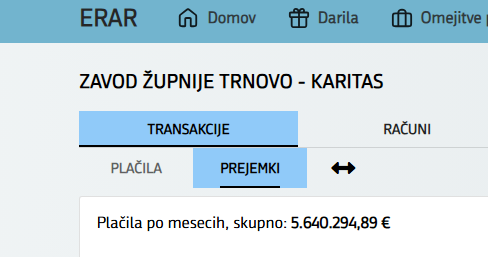
They merely listened and explained that current law does not give them authority over private concession holders. Yet, the Dom Janeza Krstnika, run by the Trnovo parish, has received €86,916.88 from the Ministry since August 2023, and €5.6 million in total public funds over the last decade (Erar database).
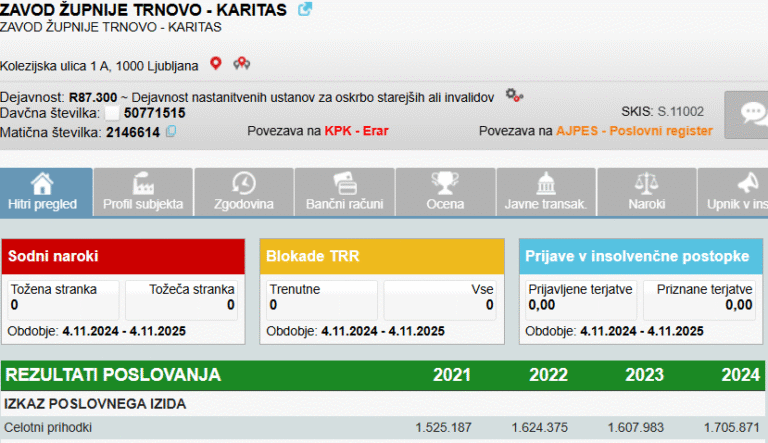
The home’s revenues keep rising, reaching €1.7 million in 2024 (EBONITETE.SI).

A Mirror of a Broken System
The case of Dom Janeza Krstnika exposes the very problems Minister Maljevac often speaks of — dignity of the elderly, care standards, and respect for workers. Yet his inaction sends a clear message: Slovenia’s long-term care system is deficient, and accountability evaporates among institutions.
As long as care homes operate as businesses and oversight remains a mere formality, stories like this will persist — reminders that dignity is not a right but a daily struggle.
About This Page
The Voice of the Elderly is a project owned and produced by Preiskovalno.si, an independent Slovenian investigative media outlet.
This page is part of our broader mission — to give voice to those who are too often unheard, especially the elderly, the vulnerable, and those living outside the circles of privilege. Through The Voice of the Elderly, we aim to expose systemic neglect, violations of dignity, and abuses within institutions of care, while advocating for transparency, justice, and respect for every human life.
The project is created and managed by journalists Nataša and Barbara, the founders of Preiskovalno.si. Our work is fully independent of political and corporate influence. We are committed to truthful, ethical, and responsible journalism that serves only the public interest.
We believe that journalism must stand as a guardian of human dignity and as a defender of those without power. Every story we investigate — from elder care to healthcare, the environment, and social justice — is grounded in facts, compassion, and the pursuit of accountability.
Preiskovalno.si holds full editorial ownership and responsibility for the content published on The Voice of the Elderly.
Support Independent Journalism
Because we are independent of capital elites and politics. Because what matters most to us are people and their rights. In a world where the voices of the weak are often silenced, where financial pressures prevent the truth from coming to light every day, investigative journalism is our last line of defense for justice and truth. Journalism in Slovenia is held hostage by construction and political interests. The media are exploited to smear individuals and settle scores with political opponents.
Your support means more than just a donation — it means you believe in a world where injustices can be corrected, a world where the wealthy cannot buy silence or block publication, and it means you believe in us. That we are brave enough to publish everything we judge to be in the public interest.
Your donation makes it possible to investigate wrongdoing, uncover hidden stories, and protect those who have no voice. You help us fight corruption, disinformation, and injustice.

English translation generated with the assistance of artificial intelligence