For almost two months, retired Branko Lukačič lived in fear—wondering whether he would even survive this winter after Slovenia’s Financial Administration (FURS) fined him heavily for helping his half-blind friend.
Even though he received no payment, neither money nor goods, the state classified his good deed as undeclared (illegal) work. Inspectors did not catch him performing an activity for profit, accepting payment, or repeatedly engaging in similar work. There was no intent of economic gain that could threaten workers’ social security or undermine the pension and healthcare funds. Despite none of the basic legal conditions being met to define his help as undeclared work, Branko was fined €1,000—the minimum by law, yet a fortune for a pensioner whose monthly income is three times lower.
A Fine Three Times His Pension
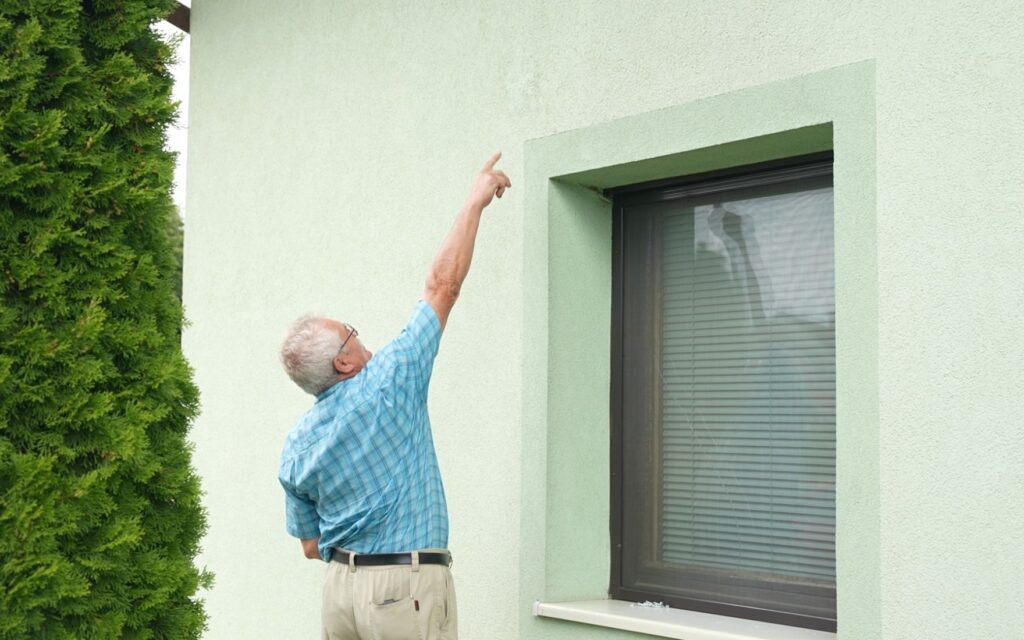
“I applied for free legal aid and appealed, since I did nothing wrong. I only helped a friend who is waiting for eye surgery. Because he couldn’t climb a ladder, I painted a few meters of eaves on his house. A few days ago, the fine was changed to a warning,” said the pensioner, relieved at the state’s decision.
Branko is among the poorest of his generation. His total pension is €370 per month. After mandatory healthcare and long-term care contributions, he is left with just €331 to live on. That must cover both him and his wife Jelka, aged 63, who cannot work due to health problems.
All photos: Mojimediji.si
A FURS spokesperson confirmed:
“We confirm that based on the appeal against the fine, the person received a warning. The Financial Administration reviewed the entire situation and all circumstances of the case. We found the field inspectors’ findings correct—that undeclared work was performed—but we also considered mitigating factors: it was the first such violation, caused by ignorance of the law, the person believed he could help his visually impaired friend from the association, the work was minor (painting eaves), and there were other life circumstances.”
“Without Our Daughters, We Wouldn’t Survive”
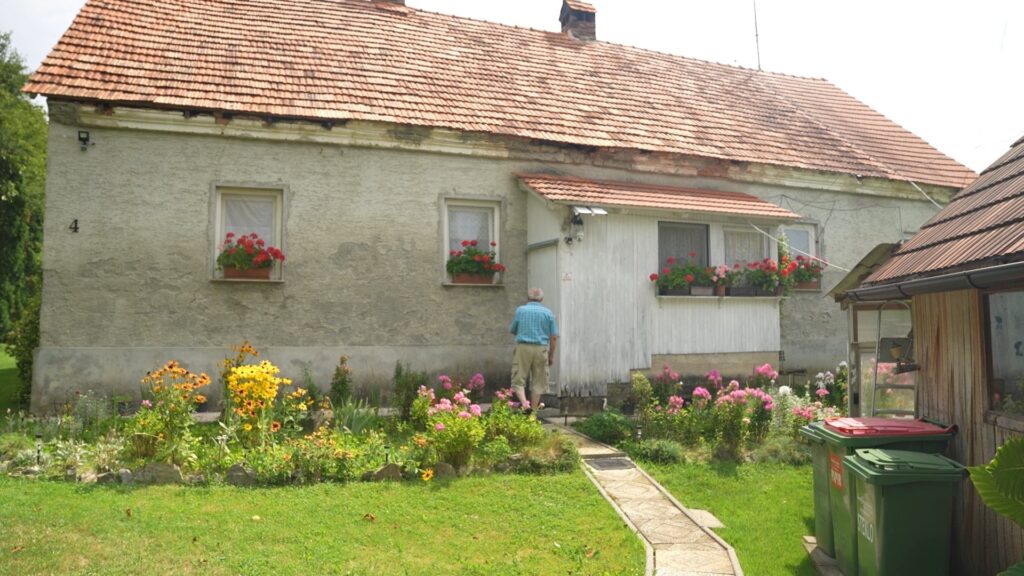
The Lukačič couple lives in Grabšinci, a small village in the municipality of Sveti Jurij ob Ščavnici, a rural area where most residents depend on farming, livestock, vineyards, or orchards to make ends meet. Here, neighbors still help one another with farm work, which is never in short supply. Especially during harvests and traditional farm gatherings, every pair of helping hands counts.
Branko’s help is appreciated in the community—and legally permitted. When we visited, he was behind the wheel of his tractor, assisting neighbors with farm chores.
His wife Jelka was gathering the last autumn vegetables from their small garden. They do not own a farm—the few plots of land around their modest home are enough only for a rabbit hutch or chicken coop. Neighbors sometimes repay their help with a crate of potatoes for the winter. Occasionally, they receive aid from social organizations that distribute leftover vegetables, bread, or near-expiry meat.
“We couldn’t survive without our daughters,” Branko admits. Before autumn, the daughters stocked their parents with winter supplies. After paying bills—at least €250 each month—the couple has only a few dozen euros left for food. They shop once a month at the cheapest store. “Every trip to the store feels like a holiday,” says Branko, especially now, as food prices keep rising. They cannot afford a vacation; instead, they are saving up for firewood for the coming winter.
The poverty risk threshold in Slovenia is €981 per month. Branko explains that the state “did not recognize 18 years of his farming insurance contributions” when calculating his pension. He is waiting to file an appeal: “If they finally count those years, my pension will go up at least a little.”
His wife receives no pension. She raised three children and later worked in local administration and public programs, but she lacks enough years of service. She gets a social supplement of around €120.
This year, the couple received a one-time social aid payment of €350, which Branko used for new glasses.
“I have double vision and need special lenses. Here they would cost €800, but in Austria they were under €300.”
A Christmas bonus would help their household budget, but due to the upcoming referendum and threats of withdrawal by Minister Luka Mesec, it remains uncertain (more on that [here]).
Voluntary Help in the Local Bylaws
Despite the bitter experience from a few months ago—when FURS mobile inspectors caught him helping a half-blind pensioner in a neighboring village—Branko has not lost his sense of solidarity. He chairs the local shooting association, which even has a rule in its statute allowing members to help each other voluntarily.
His story quickly spread across social media and national news. Many questioned the rigidity of bureaucracy and the absurdity of such enforcement practices. While FURS denies any public pressure affected the outcome, the case highlighted the need for common sense—and the fine line between neighborly help and illegal undeclared work.
Above all, it revealed the fragile social security and poor conditions of the elderly living on or below the poverty line, struggling daily with meager pensions and new state levies.
People can easily find themselves trapped in a vicious circle: low pensions, inadequate social assistance, and the risk of heavy fines if they try to help someone or earn a little extra. State policies often fail to distinguish between solidarity and profit, pushing the most vulnerable even deeper into hardship.
“I’ve always followed the rules, but apparently that’s no longer enough,” Branko concludes.
FURS: It Is Undeclared Work
FURS insists that fining Branko Lukačič was neither exceptional nor unfair—the state views his help as undeclared work. Lukačič performed construction-related tasks in another municipality. The fine was reduced due to his family’s difficult social circumstances.
“Undeclared work is any work without registration and without paying taxes or contributions. It is also illegal to employ someone without a contract and insurance or to advertise such work.”
Examples of the Grey Economy
- Performing services (painting, masonry, lawn mowing for pay, babysitting, cleaning) without registration or issuing invoices.
- Working for an employer without a contract or insurance.
- Receiving occasional payment for help (paid mowing, moving assistance, furniture assembly) without reporting it.
- Performing an activity that requires a license or notification without obtaining one (e.g. supplementary farm activity, part-time sole trader).
Exceptions
The Act on the Prevention of Undeclared Work and Employment (ZPDZC-1) defines exceptions such as neighborly help, voluntary or humanitarian work, and personal supplementary work, which is allowed if registered and within income limits. Violations carry high fines and can lead to loss of social or pension rights.
What Is Not Undeclared Work?
- Neighborly help – occasional, unpaid assistance between neighbors or relatives (e.g. harvesting crops, child care, transport, household help).
If it becomes regular or compensated (even “in kind,” such as food or firewood), it can be considered undeclared work. - Family assistance.
- Volunteer work for registered organizations or NGOs.
- Farm or mountain work during seasonal peaks.
- Short-term work (limited hours, unpaid, for household use).
- Personal supplementary work – allowed under a special regime if reported to AJPES and within income limits (no more than three average net monthly salaries per half-year).
Tax Debt Nearing One Billion Euros
There have been numerous cases where Slovenia’s tax authorities have written off millions in tax debt, or debts simply expired due to loopholes. While ordinary citizens face strict enforcement, the wealthy often go untouched.
Media have reported that the largest individual tax debtor, Zoran Trifunović, saw his €10–11 million debt expire.
In 2024, FURS removed liens and mortgages from Jure Janković’s assets; part of the debt was repaid, part expired, and courts confirmed forced settlements in the Janković family companies, writing off 95% of obligations—around €29 million owed to various creditors. There are many more cases that never reached the public (we reported on them [here]).
According to FURS’s 2024 Annual Report, total tax debt (active and conditionally recoverable) on December 31, 2024, was €901,937,257, an increase of €60,128,463 (7.1%) compared to the previous year. Active tax debt amounted to €481.8 million, and conditionally recoverable debt €420.1 million.
Meanwhile, Slovenia’s state deficit for the first nine months of 2025 is nearly €1 billion, expected to rise to €2.1 billion next year. Defense spending alone will reach €2 billion.
The state budget rescued the pension and health funds from collapse with a €1.6 billion injection.
RTV Slovenia recently reported that the healthcare fund faces a €209 million deficit next year. The government may need to either provide budget support or raise mandatory health contributions—from €37 to about €48 per month.
For Branko and other low-income pensioners, those extra €11 would mean more sacrifice and deepening poverty. With rising expenses, new taxes seem inevitable.
On one side, millions in write-offs; on the other, an ordinary man struggling to survive.
“It hurts that the state punished me for selflessly helping a friend,” Branko says. “Even though the fine was reduced to a warning, it hurts that the government proves its power at the expense of small, simple people.”
“Sometimes I take on small jobs, but I must be careful not to exceed 80 hours a month. I can mow or help tidy up, but not paint or build—that would be undeclared work. Even working just for food is forbidden. But apparently, stealing isn’t. My parents didn’t raise me to do that,” says Branko from Pomurje, who, despite everything, does not lose hope:
“We’ll survive somehow.”
Undeclared Work – What Is Allowed and What Is Not (According to ZPDZC-1)
| Activity | Allowed | Prohibited | Notes / Fines |
| Neighborly or family help | Yes | If regular or paid (even in kind) | Must be occasional and unpaid |
| Voluntary, humanitarian, or charitable work | Yes | – | Must be unpaid |
| Help on farms, pastures, or mountain grazing | Yes (seasonal) | If paid or regular | Must be unpaid and occasional |
| Personal supplementary work | Yes (if registered) | If over income limit or unregistered | Register with AJPES, report to FURS; income limit = 3 avg. net salaries per half-year |
| Short-term work | Yes (under special conditions) | If limits exceeded | Max 40 hrs/month, unpaid, for household use only |
| Paid work without registration | – | Undeclared work | Individuals: €1,000–€5,000; companies: up to €26,000 |
| Employment without contract or insurance | – | Illegal employment | Companies: €2,600–€15,600; responsible person: €420–€1,600 |
| Advertising unregistered work | – | Prohibited | Fines up to €26,000 |
Source: Financial administration of Slovenia
About This Page
The Voice of the Elderly is a project owned and produced by Preiskovalno.si, an independent Slovenian investigative media outlet.
This page is part of our broader mission — to give voice to those who are too often unheard, especially the elderly, the vulnerable, and those living outside the circles of privilege. Through The Voice of the Elderly, we aim to expose systemic neglect, violations of dignity, and abuses within institutions of care, while advocating for transparency, justice, and respect for every human life.
The project is created and managed by journalists Nataša and Barbara, the founders of Preiskovalno.si. Our work is fully independent of political and corporate influence. We are committed to truthful, ethical, and responsible journalism that serves only the public interest.
We believe that journalism must stand as a guardian of human dignity and as a defender of those without power. Every story we investigate — from elder care to healthcare, the environment, and social justice — is grounded in facts, compassion, and the pursuit of accountability.
Preiskovalno.si holds full editorial ownership and responsibility for the content published on The Voice of the Elderly.
Support Independent Journalism
Because we are independent of capital elites and politics. Because what matters most to us are people and their rights. In a world where the voices of the weak are often silenced, where financial pressures prevent the truth from coming to light every day, investigative journalism is our last line of defense for justice and truth. Journalism in Slovenia is held hostage by construction and political interests. The media are exploited to smear individuals and settle scores with political opponents.
Your support means more than just a donation — it means you believe in a world where injustices can be corrected, a world where the wealthy cannot buy silence or block publication, and it means you believe in us. That we are brave enough to publish everything we judge to be in the public interest.
Your donation makes it possible to investigate wrongdoing, uncover hidden stories, and protect those who have no voice. You help us fight corruption, disinformation, and injustice.

English translation generated with the assistance of artificial intelligence